
HELOC vs. home equity loan vs. cash-out refinance: Which option is best for you?

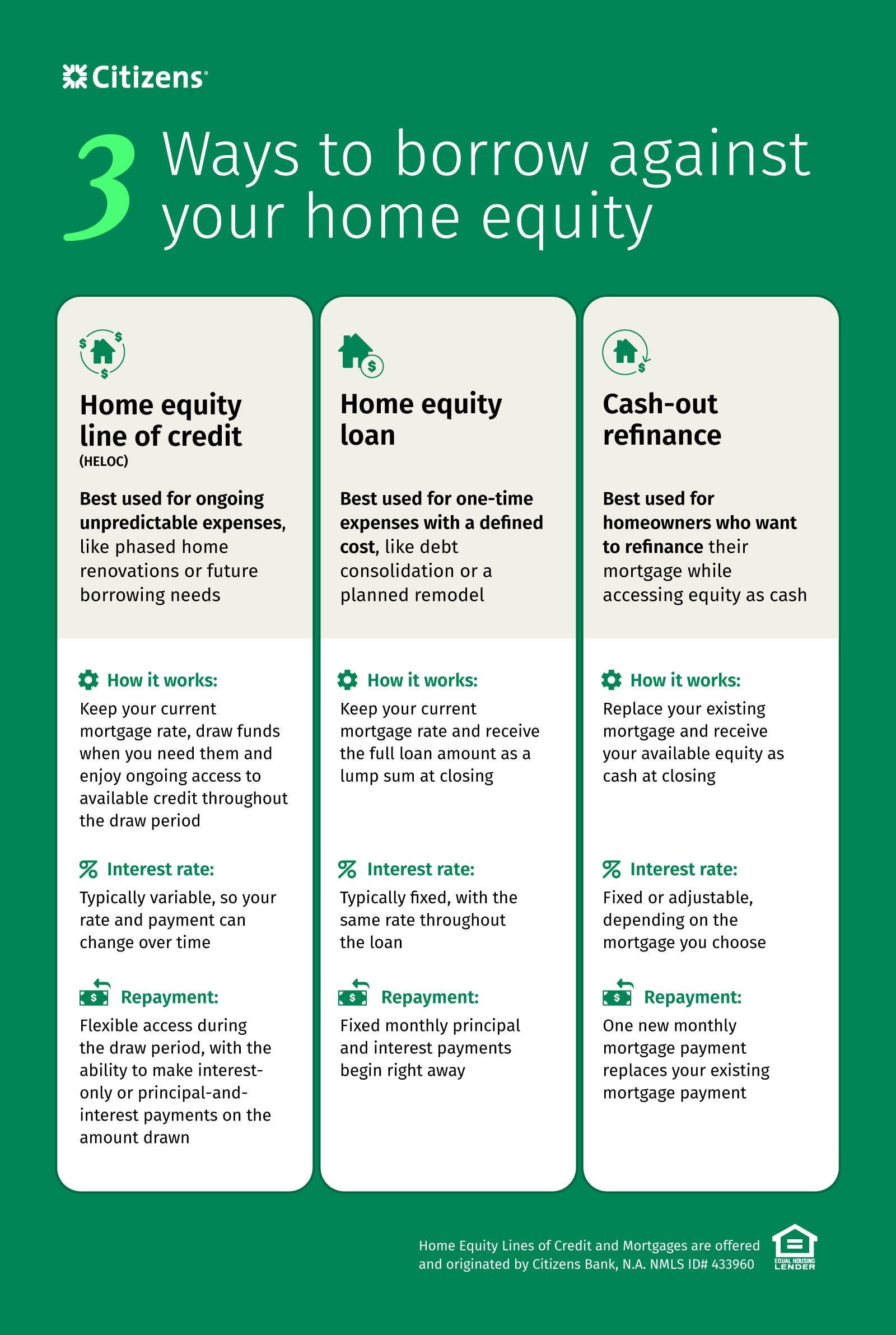
A home equity line of credit (HELOC) is a revolving credit line secured by your home, it offers the flexibility to draw as you need up to your approved amount, repay and borrow again. A home equity loan delivers a fixed lump sum at a fixed rate with predictable monthly payments that consist of both principal and interest. A cash-out refinance replaces your existing mortgage with a larger one and gives you the difference in cash.
Key takeaways
- HELOCs, home equity loans and cash-out refinances are all ways to access your home equity, but each is best suited for different situations.
- A HELOC may be a good choice for ongoing projects or when costs are uncertain because you can borrow as needed up to your approved limit.
- A home equity loan may be a good option when you know how much you need to borrow and prefer fixed monthly payments.
- A cash-out refinance may be a good fit if interest rates are lower than your current mortgage.
Home equity levels are near historic highs, with the average homeowner holding approximately $310,500 in equity. The question many face isn't whether they have enough equity. It's determining whether a HELOC, home equity loan or cash-out refinance is best for their needs.
While they all enable you to access your equity, these financing options aren't the same. They're each best for different situations, and understanding how they work makes it easier to know which one fits your financial goals. Here's how a HELOC vs. home equity loan vs. cash-out refinance works, their potential downsides and what you should ask before choosing any of them.
HELOC: A revolving credit line secured by your home
A home equity line of credit (HELOC) is a second mortgage that allows you to draw funds as needed, with your available credit replenishing when you repay what you borrow. A HELOC is a great choice for borrowers who don't want to give up their existing mortgage rate. HELOC's typically have variable interest tied to an index like the Wall Street Journal Prime Rate, and your payments fluctuate when the rate changes. However some lenders offer HELOC's at a fixed interest rate.
A HELOC has two phases: the draw period and the repayment period. During the draw period, which typically lasts 10 years, you can borrow, repay and borrow again. You can also make interest-only payments during this time. When the draw period ends, you enter the repayment period, which is typically 15 to 20 years. You repay the balance plus interest through monthly payments.
HELOCs are often ideal for projects completed in stages, like renovations, or for uncertain expenses, like rolling tuition. They can also be a source of affordable credit to cover unexpected expenses, like a new roof or HVAC system.
Home equity loan: A fixed lump sum at a fixed rate
A home equity loan is a second mortgage where you receive the full loan amount at the closing. Payments towards both principal and interest begin immediately with a fixed interest rate.
Home equity loans offer predictable payment schedules, which simplifies budgeting. A potential trade-off is that you pay interest on the full amount from day one, even if you don't need all of the funds immediately.
Home equity loans are best for one-time expenses when you know upfront how much you need. They may be a good option when you're paying off debt, making a major purchase or you know the entire cost of a renovation.
Cash-out refinance: A new primary mortgage that unlocks equity as cash
A cash-out refinance replaces your current mortgage with a new, larger mortgage. This type of loan isn't a second mortgage, though. It's an all-new first mortgage.
The interest rates for a cash-out refinance can be either fixed or variable. They're typically lower than the rates for HELOCs or home equity loans because the lender holds a first-lien position and is paid first if your home is sold or foreclosed on.
The closing costs for a cash-out refinance are typically 2% to 5% of the new loan amount. Because of these costs, a cash-out refinance may only make financial sense if you can get a lower interest rate than your original mortgage. Over time, the interest savings from the new lower rate may offset the closing costs.
Before applying, make sure interest rates aren't higher than the rate you currently have. Since you're trading your entire mortgage for a new one, even a small rate increase could add significantly to the total interest you pay. A lower rate on the cash-out portion of the loan may not offset a rate increase on the portion that replaces your original mortgage.
How to assess which option fits your situation
Which loan should you choose? These steps can help you decide the best option for your home equity needs:
1. Know your current mortgage rate
If your current mortgage rate is below 5%, carefully consider whether you'll come out ahead with a cash-out refinance. The rate benefit on the cash-out portion rarely offsets the cost of refinancing the full outstanding balance at a higher rate.
2. Define the expense type
If you know the full amount needed, a home equity loan lets you borrow a fixed amount upfront at a fixed rate. If your costs are uncertain or you're working on an ongoing project, a HELOC lets you borrow as needed up to your approved limit.
3. Estimate your payment after the HELOC draw period
Interest-only payments during the HELOC draw period can be much lower than the principal-plus-interest payments during repayment. Estimating your payment after the draw period ends helps you determine whether payments will fit your budget when you move into repayment.
4. Calculate the closing costs
For cash-out refinances, the 2% to 5% closing costs on a $400,000 new mortgage amount to $8,000 to $20,000 in upfront costs. The closing costs for HELOCs and home equity loans are typically lower, for example a Citizens HELOC has no application, origination, or closing costs.
5. Consider the tax benefits
Interest on home equity borrowing may be tax-deductible if the funds are used to "buy, build, or substantially improve" the home securing the loan. Consult a tax professional for the current IRS rules.
What qualification requirements lenders look for
The requirements to qualify for a HELOC, home equity loan and cash-out refinance are similar. However, a cash-out refinance also goes through the full mortgage underwriting process, similar to when you obtained your first mortgage. Lenders will review your:
- Credit score: Lenders typically require a minimum credit score of 680, although scores of 700+ may qualify for better terms.
- Debt-to-income (DTI) ratio: No more than 43% to 55% of your gross monthly income should go toward your monthly debts.
- Loan-to-value (LTV) ratio: The combined balance of your mortgage and equity loans typically can't exceed 80% to 85% of the home's appraised value.
If you're considering a HELOC, a calculator can help you estimate the credit amount you may qualify for. An official offer depends on your credit profile and a review of your financial information.
Choose the right tool for the right moment
HELOCs, home equity loans and cash-out refinances are like tools in a toolbox, and each is best suited for different projects and needs. Before applying, determine whether you need to borrow a lump sum or borrow periodically. If you're considering a cash-out refinance, compare your mortgage interest rate to the current rates to ensure you'll come out ahead.
Thinking about applying for a HELOC? Get your HELOC rate today with no impact to your credit score.
Frequently asked questions
Can I have a HELOC and a home equity loan at the same time?
Yes, you can have both types of loans at the same time. It depends on how much equity you have in your home and the total amount you're borrowing against.
What happens to my HELOC if I sell my home?
Your HELOC must be paid off at the closing if you sell your home. This is typically done using proceeds from the home sale.
Is interest on a HELOC or home equity loan tax-deductible?
Interest on a HELOC or home equity loan may be tax-deductible if the funds are used to "buy, build, or substantially improve" the home securing the loan. Consult with a tax professional for current IRS rules.
Related topics

5 things to do with a HELOC
Learn practical ways homeowners can put their equity to work, from renovations to major purchases, and what to consider before tapping it.

9 ideas for eco-friendly home improvements using a HELOC
Upgrading to an eco-friendly home can offer substantial savings and a positive environmental impact.

5 home equity lines of credit (HELOC) myths debunked
Get clarity on common HELOC misconceptions, and separate fact from fiction to make more confident borrowing decisions.
© Citizens Financial Group, Inc. All rights reserved. Citizens Bank, N.A. Member FDIC
Home Equity Lines of Credit are offered and originated by Citizens Bank, N.A. (NMLS ID# 433960)
Disclaimer: The information contained herein is for informational purposes only as a service to the public and is not legal advice or a substitute for legal counsel. You should do your own research and/or contact your own legal or tax advisor for assistance with questions you may have on the information contained herein.
